Get to know the state’s big trees
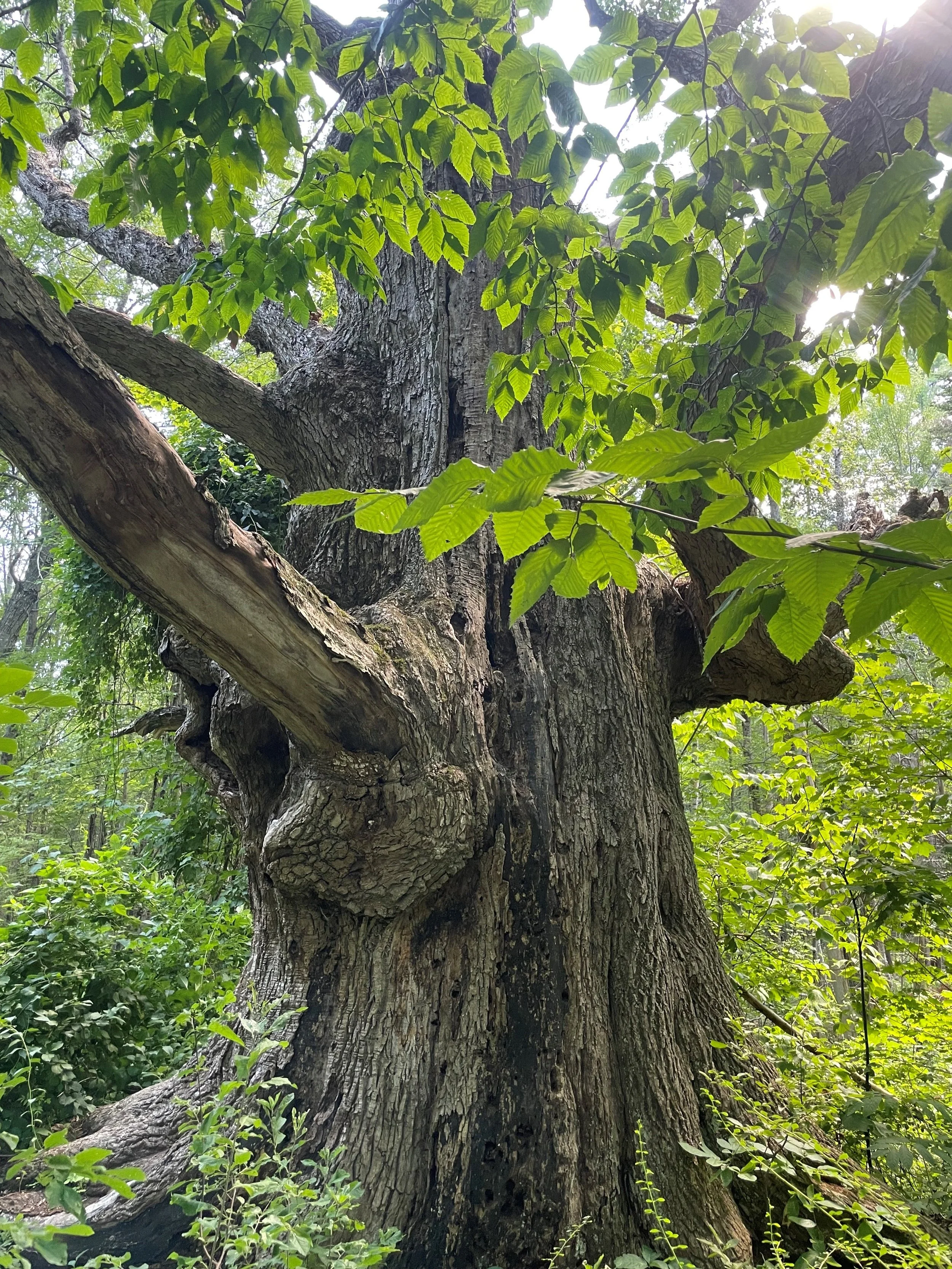
Gnarled and ancient, Maine’s state champion white ash, located in Waterford, has been on the Maine Register of Big Trees since the list’s inception in 1968.
By Andrea Lani
Photos: Jan Ames Santerre
DEEP IN THE FOREST behind my house grows a white pine that my family calls Owl Tree after the barred owl we saw perched in its branches on New Year’s Day 23 years ago. It’s the largest tree on our property; two adults reaching around its trunk can just clasp hands, and its crown rises well above the surrounding forest. Whenever I walk in the woods, I pause to bask in its wise and comforting presence.
“There’s something really special about big trees,” says Jane Ames Santerre, Project Canopy Coordinator at the Maine Forest Service.
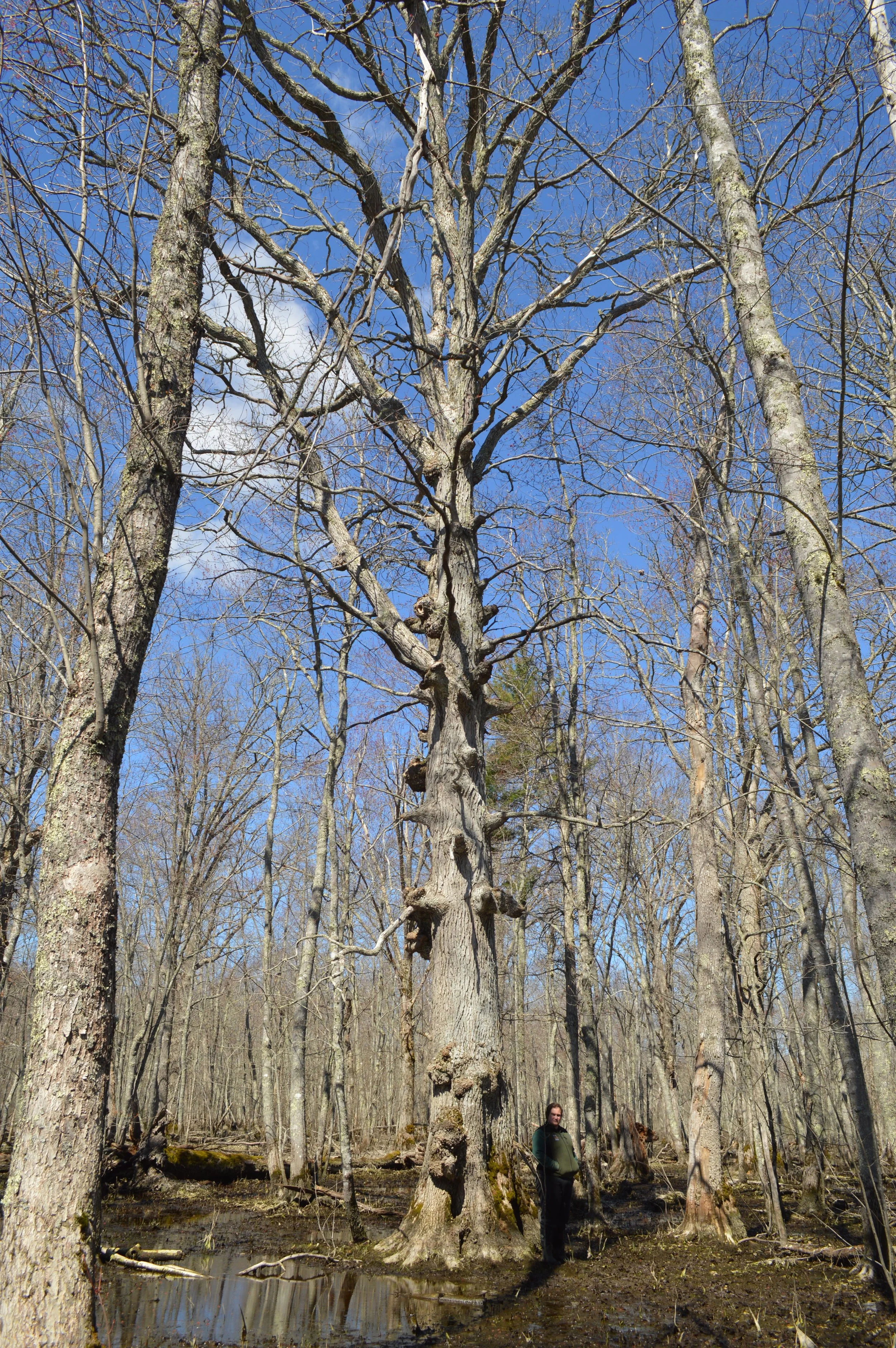
Maine’s champion swamp white oak stands tall in Warren.
On a balmy morning in April, Santerre and I trek into the woods to see just how big Owl Tree is. After giving the tree its due admiration, Santerre wraps a logger’s tape around the trunk to measure a girth of 110 inches. Next, standing back at a vantage from which she can see the top of the tree, she uses a digital clinometer to determine that it’s 90 feet tall. Finally, we each hold one end of a long metal measuring tape to find that the distance between the outer tips of the branches is 58 feet.
Owl Tree’s size is impressive, but it has a ways to go to catch up with Maine’s state champion eastern white pine, a tree located in Sumner that is 222 inches in circumference and 105 feet tall with a 58-foot crown spread.
Since 1968, the Maine Forest Service has maintained the Maine Register of Big Trees, a list of the largest known native and naturalized trees in the state. Potential champion trees are nominated by property owners, land managers or anyone who encounters a large tree and submits preliminary measurements. If a nominee appears to be a contender, a District Forester will measure the tree’s circumference, height and average crown spread. These numbers are combined to create a score, and the tree with the highest score emerges as the state champion for that species.
Santerre continuously updates a database of these big trees, and she publishes the register periodically. The most recent register, published in 2020, lists 146 trees representing 138 different species (trees with close scores share a co-champion designation). While the list provides a limited amount of scientific and historical data, Santerre says its true purpose is “about connecting people with the land, to help promote the growing of trees and stewardship of the land.”
There’s also a National Champion Tree Program that compiles a register of the largest trees in the country. Five of Maine’s big trees make the national list: a yellow birch in Wayne, Sumner’s eastern white pine, a mountain paper birch in Bethel, a black spruce in Brooklin and a black maple in York County.
While designating certain trees as the biggest in the state or country appeals to humans’ competitive nature, the trees themselves inspire wonder. Santerre describes taking a group of young adults to see the state champion red oak on the grounds of the former Augusta Mental Health Institute. “They were just enchanted,” she says. “People’s faces light up when they see something that much bigger than us.”
Santerre’s favorite big tree is a white ash growing in Waterford that has maintained its champion status since 1968. “It shows how trees can stand the test of time,” Santerre says. “It’s really quite a magnificent tree.”
Many of the trees on the register are integral to the communities in which they grow or are steeped in lore. When Herbie, the former state champion American elm, succumbed to Dutch elm disease, wood from the tree was turned into furniture, jewelry and art paper. The woman who had named the tree a half-century earlier came back to Yarmouth to join the committee that organized the tree’s memorial. The state champion bur oak, which grows on the property of The Mill Agent’s House in Vassalboro, is said to be a “grounding spirit” and is a key element of the property owner’s haunted house tours. “So many of the [big] trees have stories,” says Santerre, “and the stories are ultimately about the people” who live among and love the trees.
In addition to being important touchstones for humans, big trees serve valuable ecological functions. “A big tree is more of everything than a small tree,” The magnificent crown of Maine’s state champion sugar maple shades an entire yard in Whitefield. Santerre says. Big flowering trees attract more pollinators. Big fruit- or seed-bearing trees produce more food for wildlife. Big trees provide more habitat, create more shade, retain and filter more stormwater, sequester more carbon, and produce more oxygen than their smaller counterparts. Big trees generate more of “all of the good things trees provide to society,” Santerre says.
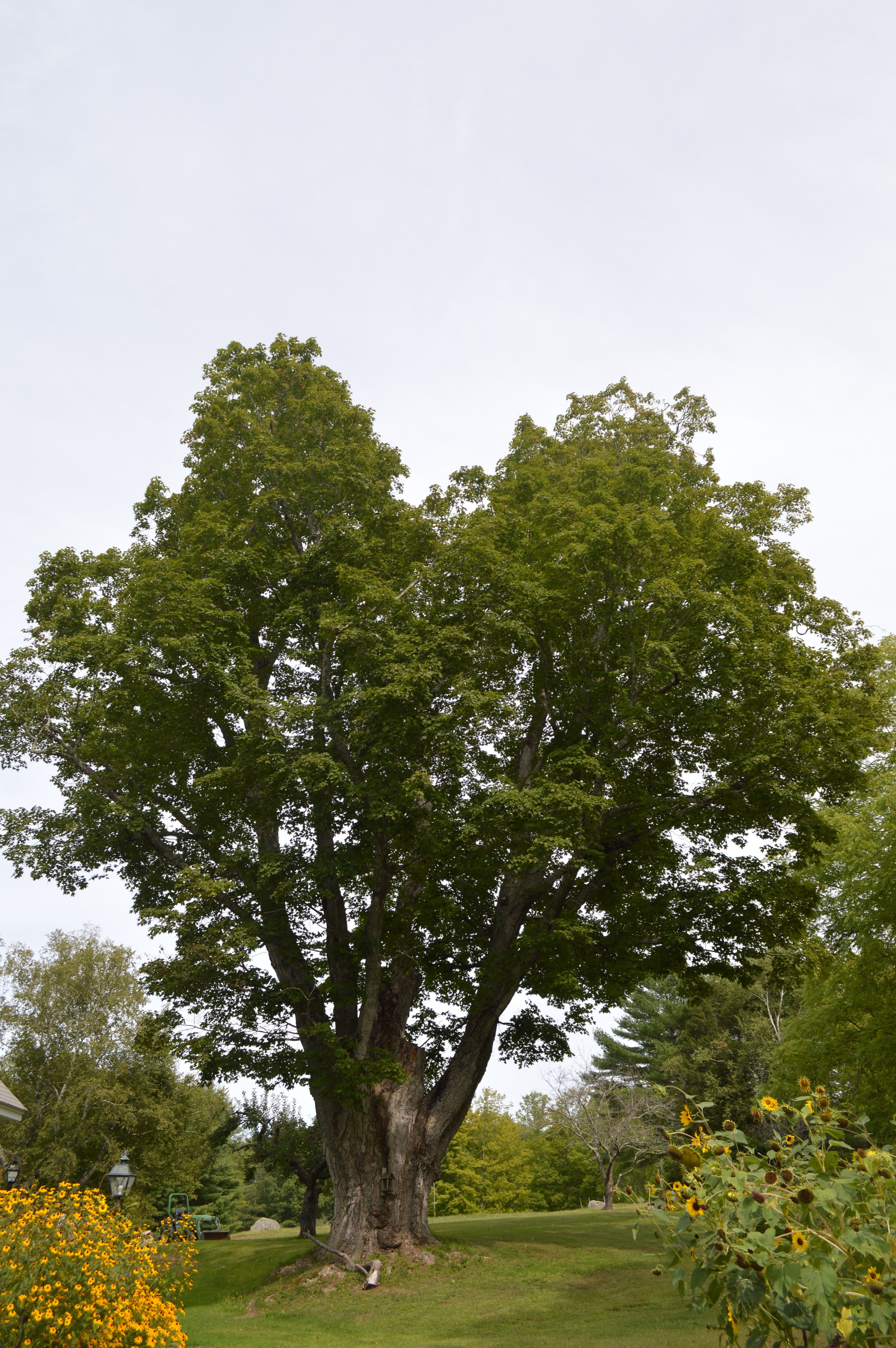
The magnificent crown of Maine’s state champion sugar maple shades an entire yard in Whitefield.
However, she notes, not all the trees on the register are what we would think of as grand in size. Many of our flowering trees, like serviceberry, native plums and dogwoods, grow to a modest size compared to towering oaks, pines and hemlocks. These trees still serve important roles in providing food for pollinators and fruiteaters and beauty to our landscapes.
If the trees in your yard aren’t yet Big Trees, you can help ensure their good health so that someday they might grow to be champions. Santerre recommends maintaining a ring of light mulch around the tree’s base, watering during dry periods (while avoiding overwatering), pruning, monitoring for disease and insects, and protecting the tree from damage from lawn mowers and other equipment. She does not recommend fertilizing established trees.
Santerre plans to include coordinates of champion trees located on public lands with the next publication of the Maine Register of Big Trees. In the meantime, you can contact her at Jan.Santerre@maine.gov for the locations of specific, publicly accessible trees. In addition, the book Big Trees of Northern New England by Kevin Martin, lists includes maps and directions to several of Maine’s big trees.
Visit Maine’s Big Trees
The most recently published Maine Register of Big Trees can be found online here. About half of the trees on the register are located in publicly accessible areas such as city and state parks, cemeteries or along city streets. Below are a few places where you can go to see some of Maine’s champion trees, along with their map coordinates.
Among the large trees shading Portland’s DEERING OAKS PARK are three state champions: green ash, Siberian elm and pin oak. Also in Portland, EVERGREEN CEMETERY hosts the state champion Austrian pine. 43°39’33.02”N 70°16’06.41”W
The grounds of the former AUGUSTA MENTAL HEALTH INSTITUTE boast several massive red oaks, including the state champion. The tree can be accessed via a short path that leads off from the Greenway Trail bike path. 44°18’19.97”N 69°46’17.01”W
While many of the American elms that graced the streets of CASTINE have recently succumbed to Dutch elm disease, including a former state champion, dozens of large specimens of this beleaguered species still stand on Battle Avenue, Court Street and Perkins Street. 44°23’08.32”N 68°48’05.76”W
One of Maine’s co-champion red pines grows in MOUNT BLUE STATE PARK in Weld. The tree can be seen from the trail that leads from the nature center south along the shore of Webb Lake. 44°40’35.82”N 70°26’25.45”W
Our state champion eastern hemlock stands tall at PEAKS-KENNY STATE PARK in Dover-Foxcroft and can be seen from the half-mile Cove Trail that starts at the beach picnic area. 45°15’41.91”N 69°17’30.93”W