Finished with love: crafters help to soften loss
A Maine nonprofit helps unfinished projects—and grieving families—find closure.
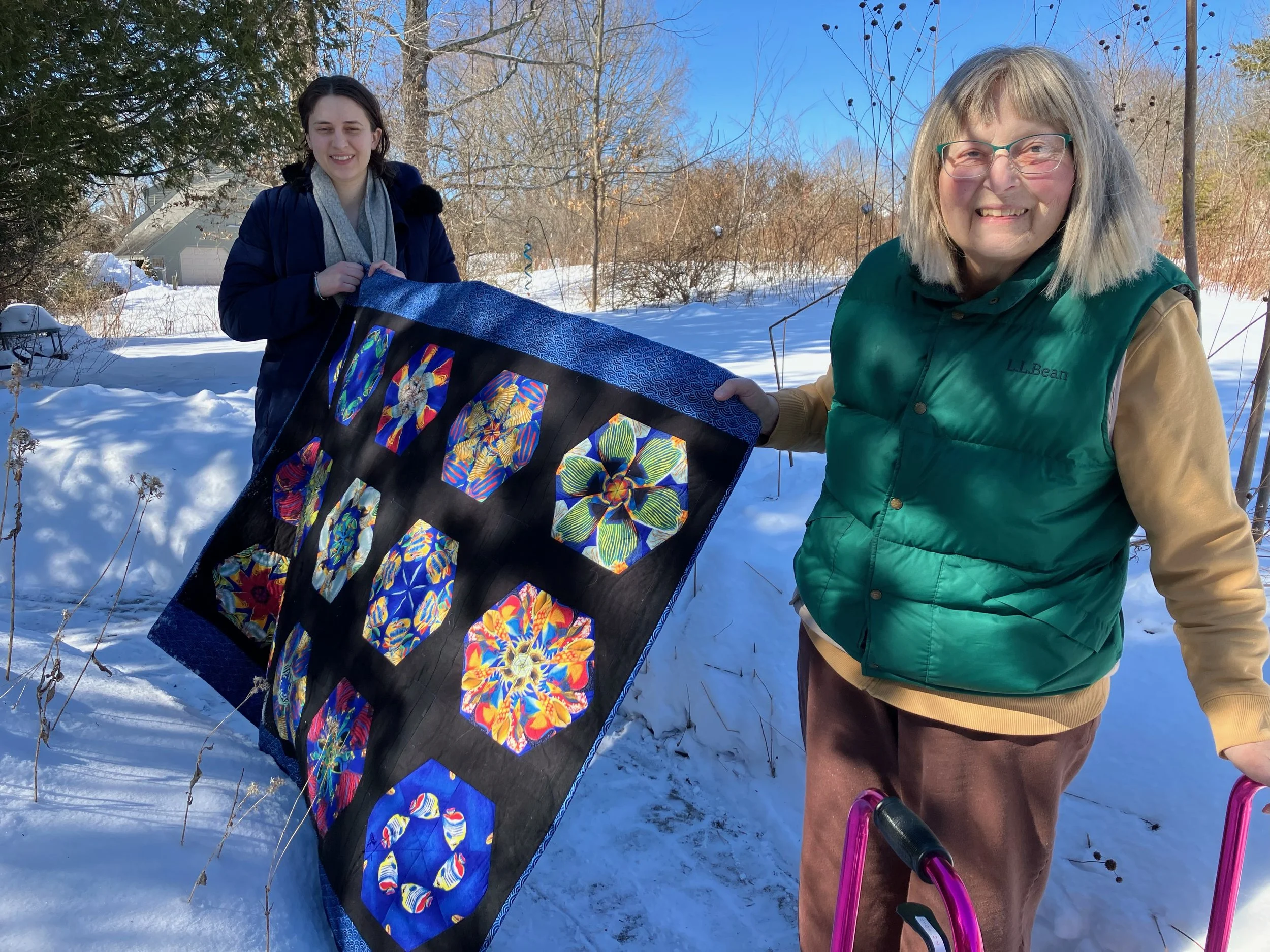
Carol Marshburn of Gorham (at left) started quilts for her two young daughters 25 years ago and was unable to finish them due to illness. Emily Drummond of Freeport and her aunt Penny Myles of Cumberland finished the quilts last winter. Here, Lake Ersek (at left) is holding her butterfly quilt with her mother. COURTESY PHOTO
By Amy Paradysz
WHEN KIM CAPONE-SPRAGUE of South Portland wears her hooded wool sweater, it feels like “a big Nanny hug” from her beloved grandmother. The tag inside even says “Made especially for you by Dorothy Sprague.”
Like anything hand-knit, this sweater was a labor of love. But it was also a relay, completed a year after Sprague’s death by Anne Turner of Yarmouth, one of 37,000 Loose Ends volunteer “finishers” worldwide.
In the 3½ years since the nonprofit Loose Ends was cofounded by Masey Kaplan of Portland, volunteers in 15 countries have taken on thousands of projects. The number of people interested in serving in this way is so high that the ratio is 10 finishers waiting for each project that comes in.
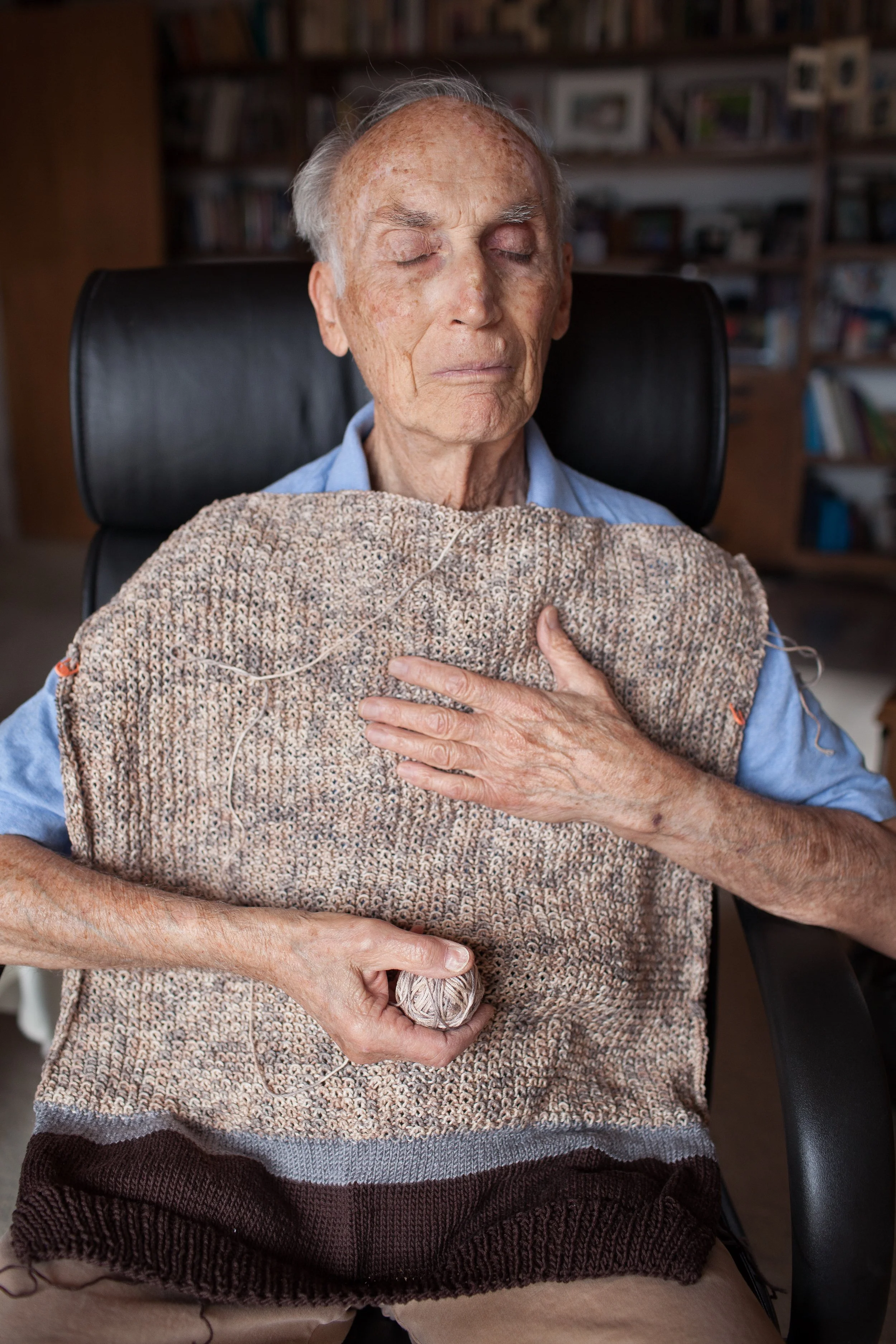
This photo was taken by Beate Sass, of her father, after her mother’s death. Loose Ends was able to match this project with a finisher and have it completed in time for his 89th birthday. COURTESY PHOTO
“Crafters are eager, generous helpers,” Kaplan says. “We hear from people all the time that they buy half-finished projects at Goodwill or estate sales and finish them. But Loose Ends offers an added layer: returning something to a family that had been started by their loved one. Something they thought was lost can ease grief and offer some comfort.”
Capone-Sprague’s Loose Ends experience began in a yarn shop, where she bought organic gray wool and a cableknit sweater pattern and asked her grandmother to “just add on a hood.”
“I thought she’d figure it out,” Capone- Sprague says. “Every grandchild got a baby sweater with a little gnome-like hood with a pom-pom, so she knew how to make a hood. But when I put it on and put up the hood, it was one of those gnome hoods. It didn’t have a pom-pom, but it might as well have. I couldn’t wear it.”
And she couldn’t say anything to hurt Nanny’s feelings either. So, the sweater sat. Unworn.
Then, about a year after her grandmother’s death, Capone- Sprague saw a TikTok reel about Loose Ends. She went on the website, uploaded photos and wrote about her grandmother.
Turner, whose sweater-knitting hobby outpaces her family’s sweater needs, had been waiting for a Loose Ends project when she heard about Capone-Sprague’s request. The two women met twice: once to pass along the sweater and extra skein of yarn, and a week later to deliver the beautiful “Nanny sweater” Capone-Sprague had pined for.
“It feels good to take something that somebody started and finish it,” Turner says. “And this was an easy one for me. All I had to do was unravel the existing hood and knit a new one that fit.”
At the time, the women were strangers. Turner hadn’t realized that she knew Capone-Sprague’s husband and mother-in-law from church—it was the hyphenated surname that gave that away. And, while Turner knew Kaplan from when they were churning out warm hats for asylum seekers, Capone-Sprague was surprised to hear that Loose Ends has a local origin story.
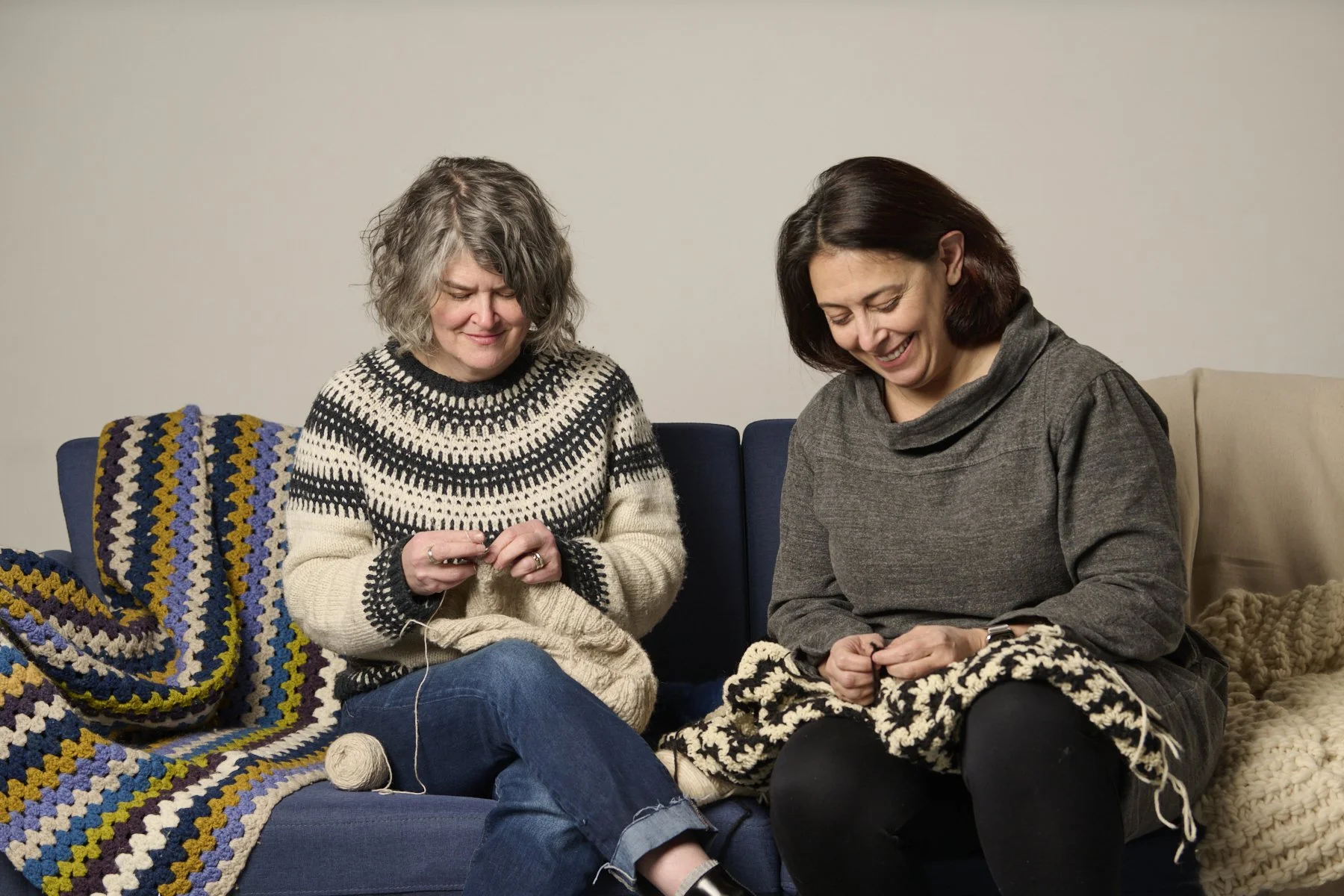
Loose Ends Executive Director Masey Kaplan and co-founder Jen Simonic. PHOTO: WINKY LEWIS
Kaplan says, “Early in the pandemic, my friend lost her mom and asked if I would finish her mom’s sweater she was making. And I did. We ended up dipping it in some dye to make it a better color for her. And then I got to see her wearing it, and it felt so good to be able to finish it for her. I thought, ‘There has to be a way for more of this to happen and to get people together who need this service.’”
That idea percolated for a few years. And then, in 2023, the Kaplans were visiting West Coast friends who had just lost a family member.
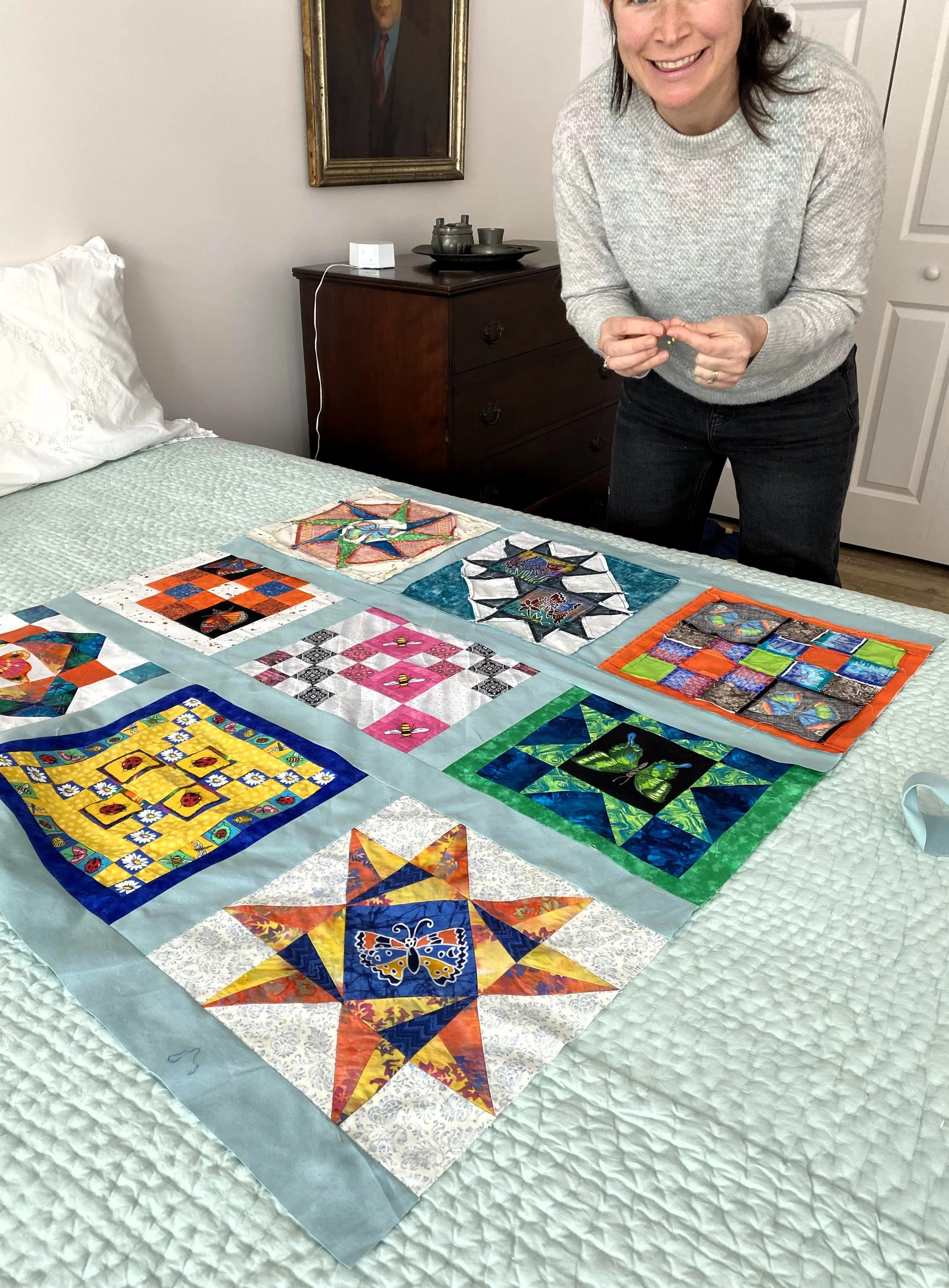
Emily Drummond of Freeport doing finish work on a quilt originally begun by Carol Marshburn of Gorham. COURTESY PHOTO
“My friend Jen [Simonic] and I went through a bag of craft stuff that Patty’s mom had left behind, and at the bottom of the bag we found two crocheted blankets that her mom had started for Patty’s two brothers. We were just about to each take one and say we’d finish it. And that was the moment, when I paused and asked Patty, ‘What would you think about letting us use these for a pilot?’”
Kaplan and Simonic turned the idea into a nonprofit and set up the database they use to match requesters and finishers. And then in December 2023, an NBC affiliate in Seattle did a story on Loose Ends.
“It snowballed from there,” Kaplan says. Knitting, crochet and quilting requests are the most common, but projects have included needlepoint, cross-stitch, embroidery, and punch-needle rugs. Volunteers have even moved looms across cities for large-scale weaving projects.
“Anything that’s made with a string, we’ll do,” Kaplan says. “And we’ve done other things, too, like chair caning and complex beading projects. There have been some outliers, like tatting, nail-binding and hairpin lace. Someone even finished a writing project. And someone submitted a painting. Those are the kinds of things that are trickier to know what the original maker intended. With a craft— like a sweater—it’s pretty clear what the intention was. But when people submit other things, we have the army to do it, and we might as well introduce them. Our five-year plan is to branch into woodworking.”
Loose Ends starts by collecting data—the requester’s address, the project, the skill level required, and a short bio of the original maker—and then the team considers potential finishers in that area. One of Loose Ends’ two staff members—2.25, to be exact—chooses a finisher based in part on geography so that an irreplaceable project doesn’t usually have to go in the mail.
“Sometimes they don’t just meet up,” Kaplan says. “Sometimes they develop relationships or even give lessons in the craft. It’s about relationships. A lot of times, our finishers talk to the person who is gone. They’ll say, ‘Okay, I have to take your stitches out in this corner, but I think you’d want that.’ It’s a conversation. We’re fulfilling the wishes of the original maker. But, also, having a tangible reminder of someone you lost can be comforting and powerful. Their fingers have touched every little part. As a crafter myself, when people wear my stuff, it feels like I’m hugging them. That’s what we’re doing.”